Skip to content
Stark Insider
  • Culture
  • Filmmaking/Tech
  • Atelier Stark Films
News Tech

Average time users spend on Google+ drops again – 3 reasons why

With so many technophiles in its corner, Google+ is the first successful niche social network, and proves that the one-size Facebook model is not necessarily the future.

BY Clinton Stark — 04.16.2012

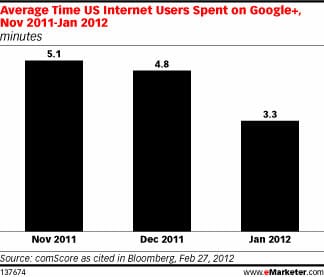
While the Google+ social network has signed up significant numbers of users since its July 2011 launch, it’s not seeing nearly the same engagement as rivals such as Twitter and Facebook.

Comscore has released its January 2012 numbers for Google+. According to the report, for the third consecutive month, the average time users spent on the social network has dropped. The average time users in the US spent on the social networking site was down to 3.3 minutes in January 2012, from 5.1 minutes in November of last year.

This from Kimberly Maul, eMarketer writer/analyst: “Google+: Influencing the Integration of Search and Social.” “However, engagement and participation aren’t up to speed with other social networks, and that has become a major obstacle for turning Google+ into a relevant social network.”

Potential theories for the decline abound:

(a) A user is producing less content, or she’s found a bullet-friendly format that makes content rapidly digestible.

(b) With much more interesting new alternatives such as Pinterest and Instagram (that differ significantly from Twitter and Facebook), we’re reaching a social saturation point, where only social networks with compelling new features garner attention.

AND/OR

(c) With so many technophiles in its corner, Google+ is the first successful niche social network (MySpace, my regrets), and proves that the one-size Facebook model is not necessarily the future.

While we’re at it, how is it possible not to suggest that Google+ is the spitting image of Facebook? If Zuck had followed in Page’s footsteps with Facebook could you imagine the uproar?

G+ is in some ways a much better Facebook. For example, Hangouts and Circles are both superbly designed, marquee features. But Google’s desperate reliance on lassoing us all in from all parts of the web — Gmail, Search, Picasa, etc. — reeks of a social Hail Mary.

Tags:Google

Related Stories

2026 Artificial Intelligence Index Report from Stanford HAI

Stanford's 2026 AI Index: Where AI Actually Stands (report)

News
Ethereal oil painting in blue and ochre tones showing overlapping figures emerging from an atmospheric haze, representing accumulated memory and continuity in human-AI collaboration. Original artwork by Loni Stark.

What Happens When the AI Remembers You

Tech
Diagram showing how Google's TurboQuant compresses high-dimensional AI vectors into a compact quantized grid, with four colored vector arrays (green, blue, red, pink) mapping to and from a central quantization matrix

Can You Fit a 70B Model on a Single RTX 5090? Google's TurboQuant Says Yes

Tech
Claude Code conversation showing how it initially built deterministic scripts for the Finn financial scout agent before being redirected toward heartbeat-driven agentic design with OpenClaw

Don't Let Your AI Agents Become Glorified Cron Jobs

Tech

More in Tech →

Clinton Stark

Filmmaker and editor at Stark Insider, covering arts, AI & tech, and indie film. Inspired by Bergman, slow cinema and Chipotle. Often found behind the camera or in the edit bay. Peloton: ClintTheMint.

Short Films
Loni Stark - A West Coast Adventure - A Lifetime in the Making - Stark Insider

Stark Insider
  • CULTURE
  • BEST OF AI
  • FILMMAKING/TECH
  • ATELIER STARK FILMS
  • HUMANxAI SYMBIOSIS
THE STARK COLLECTIVE
  • THE STARK CO
  • STARK INSIDER
  • STARKMIND
  • ATELIER STARK
© Copyright 2005-2026 BLG Media LLC. v2.18.1
  • Review Policy and Shipping
  • Privacy Policy
  • Contact
  • About