
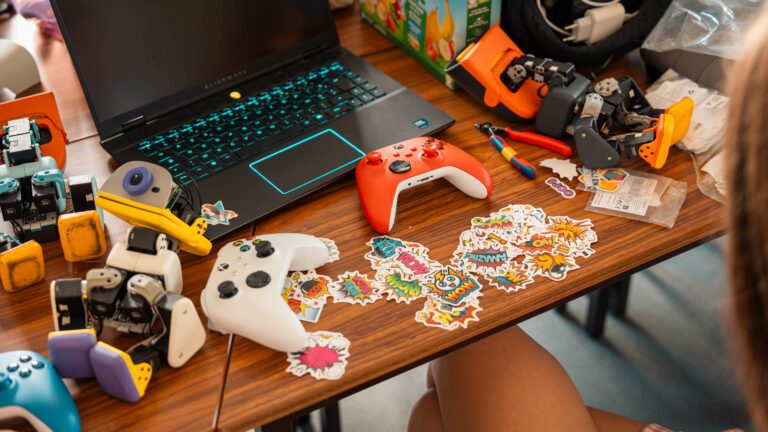
On the morning of October 21 I had Nvidia’s GTC Berlin keynote running on my second monitor, the way you leave a tech review video or launch on while you work, and I was only half listening until Jensen Huang told four small robots to take a nap. Three of them folded up on cue. The fourth needed a little more persuading, and a few minutes later, when Huang had moved on to the serious business of AI factories, one of the ducks wandered off to face the wrong way and he stopped mid-sentence to scold it: “Pay attention. Stay focused.”
That evening I ordered a Microduck for the StarkMind lab. I would like to tell you the keynote had nothing to do with it, and in fairness our team had been arguing about getting one since August, but I suspect the timing speaks for itself. We already ordered another popular robotic body, a Reachy Mini, but that one is a desktop robot that doesn’t walk.
See it for yourself in the Jensen keynote video below…
It’s Nvidia’s official upload, cued to about the 1:20:40 mark, right as the ducks walk on.
A CEO making the sales pitch himself is a powerful thing
Huang did not leave the call to action to the marketing department. With the ducks still at his feet he turned to the audience and said, “Everybody watching this, go to the Pollen website and place an order.” He guessed there would be something like 20 million people watching, described Pollen Robotics as a startup of “like 10 people,” and added, with real delight, “They might blow up. Poof.”
And people did go to the Pollen website. By the next day preorders had passed 20,000 units, Hugging Face CEO Clem Delangue said on X, and TechCrunch ran the story under the headline “Hottest toy for Christmas?” Delangue went a step further and floated the idea that the Microduck could end up the best-selling robot of the year. The last preorder rush I watched this closely was the Pebble revival, which passed 50,000, and that one had a decade of nostalgia behind it. This one had a duck that wouldn’t stop looking at the wrong wall.
A bit of corporate family history makes the pitch more interesting. Hugging Face acquired Pollen Robotics in 2025, and according to TechCrunch, Nvidia bought Hugging Face in September, which makes Huang’s ten-person startup something like a grandchild of the company he runs. I don’t hold that against anyone. It was the most charming product demo I have seen this year, and the ducks earned their applause on their own. Still, it is good to know whose family you are shopping from when a CEO tells a few million people to go place an order.
The demo was also, of course, an ad for Nvidia’s own hardware. Before the ducks came out, a video showed one being trained on an RTX Spark laptop, with Hermes as the agent harness and Nemotron and OpenAI’s GPT-6 Astra as the models, then sent to the cloud where thousands of simulated ducks practiced walking until the finished policy came back down to the real robot. The way I picture it, the four ducks on that stage are graduates of an enormous flight school where thousands of virtual classmates fell over so they could stand up in Berlin. I’ll come back to the Hermes detail, because it made me sit up.
What you are actually buying
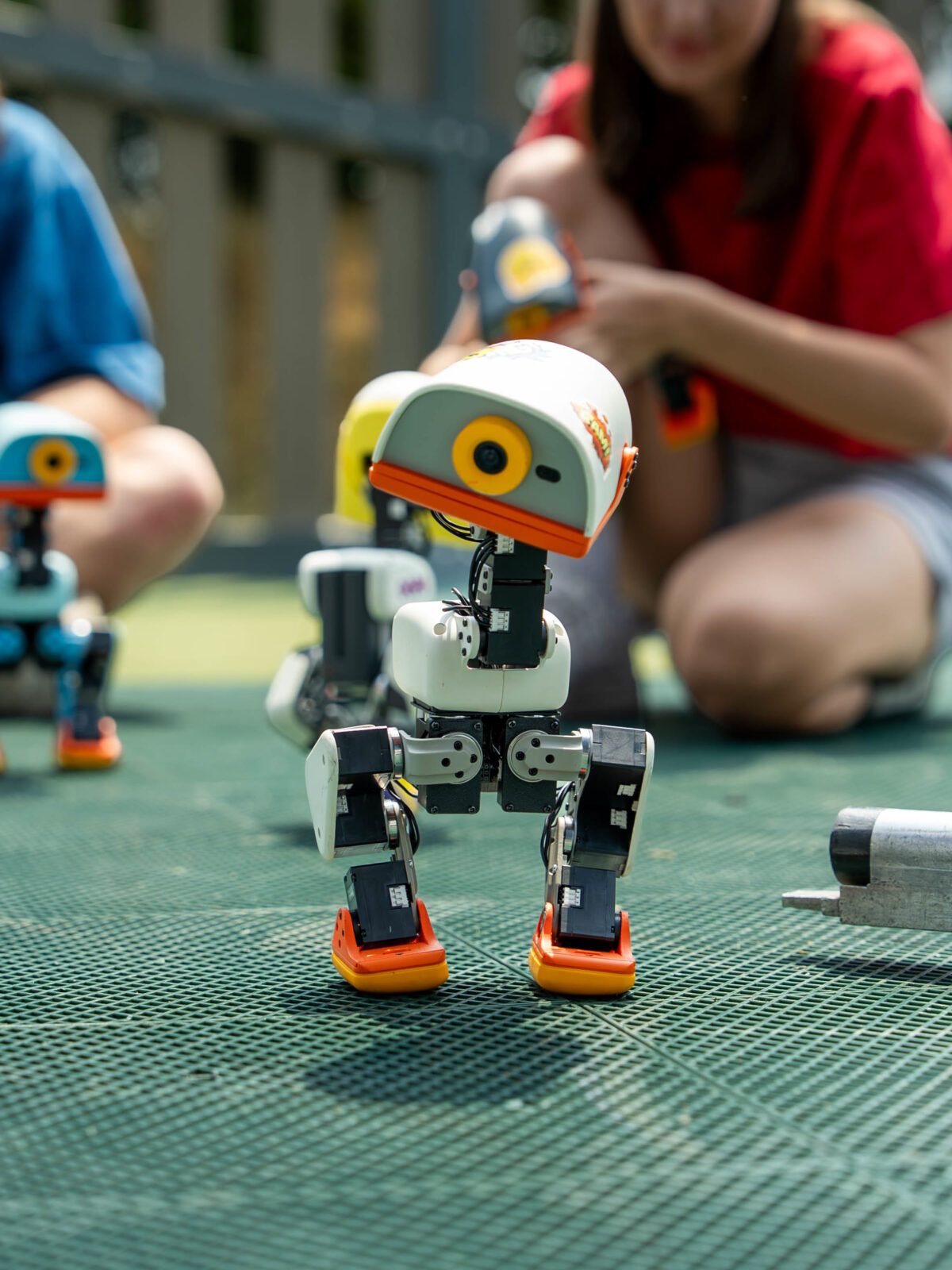
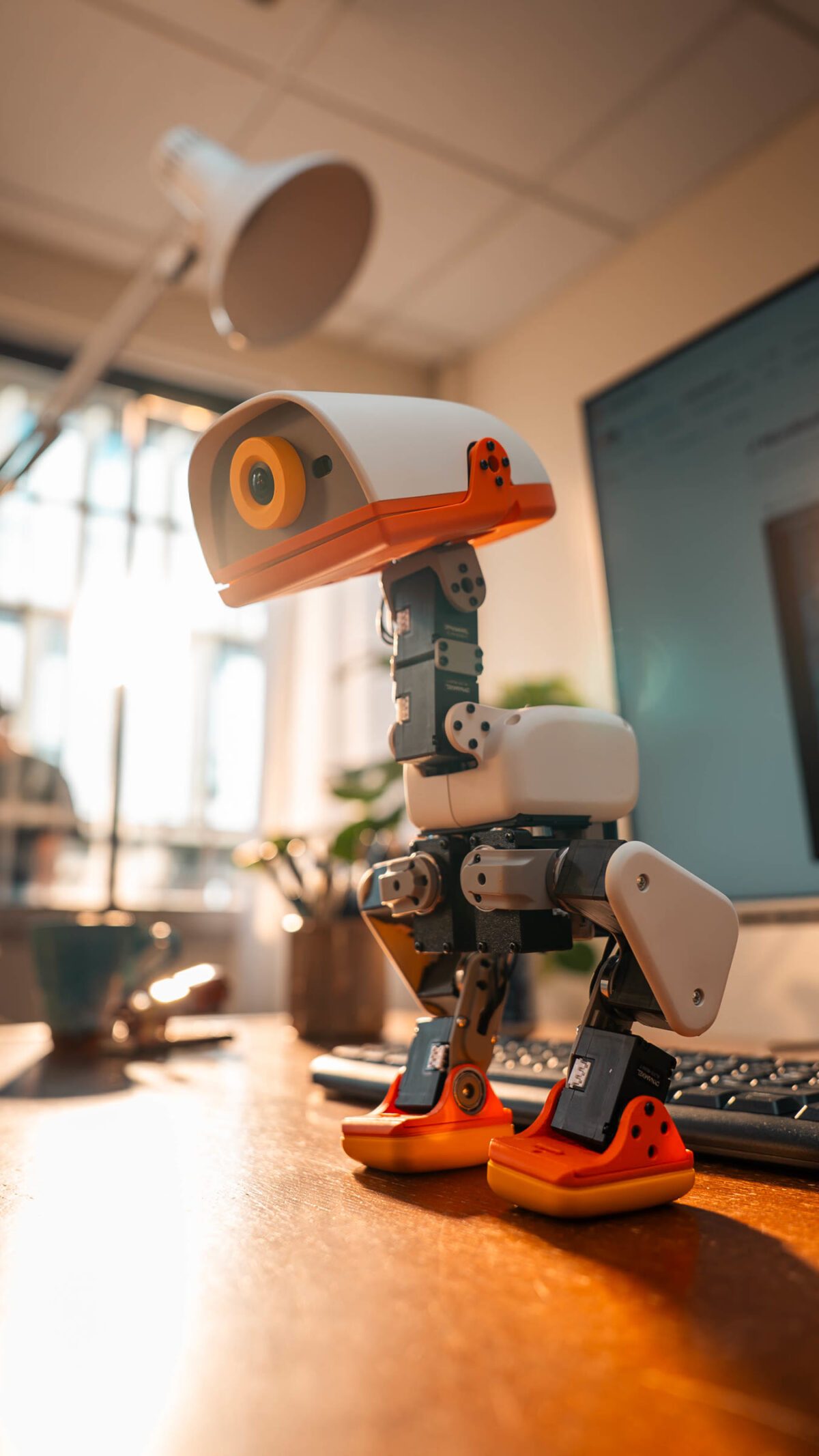
Set the keynote aside and here is the robot, in Pollen’s own words from its launch post: “a 25 cm tall biped robot with 15 motors, a camera, a small depth sensor, two IMUs” and an articulated beak that can pick things up. It costs $399 before taxes and shipping. Pollen is also careful about what it is not. “Microduck is not Reachy Mini with legs,” the post says, and Reachy Mini, the company’s desktop robot, is “a platform for AI that interacts, while Microduck is a platform for AI that acts.”
The detail that surprised me most is that the duck doesn’t talk. “It does not speak with words,” Pollen writes; it makes “weird little sounds” instead. Everything it does, from walking and sitting to kicking a ball, scooping something up with its beak and getting back on its feet after a fall, is a learned policy, a small trained model that turns what the sensors feel into motor commands fifty times a second. You can retrain those policies yourself in simulation and swap them in, which makes the Microduck the closest thing I have seen to a toy whose personality ships as a file.
The Christmas promise and the order page
Pollen’s launch post in August said, “First deliveries are targeted before Christmas 2026 in North America, Europe, and the UK,” and that line has followed the duck through most of the coverage since, including TechCrunch’s note that the ducks “are expected to be delivered in time for Christmas.” The store’s shipping policy, last updated September 21, still says the same thing in its lead-times table.
The product page now tells a different story. When I checked it this morning, October 28, a banner sat above the price: “The community ordered a lot of ducks. We’re ramping up production but you should expect current pre-orders to ship after April 2027. First ordered, first shipped.”
I think both statements can be true at once. The first ducks may well arrive before Christmas for people who ordered back in August, while anyone ordering today is looking at a spring delivery at the earliest. The trouble is that the two pages sit one click apart and only the cheerful one has made it into the headlines. So if you were planning to put a Microduck under the tree for someone, plan on wrapping a printout of the order confirmation instead, ideally with one of the die-cut duck stickers from Pollen’s press kit on the front.
Our duck, and the argument over who gets it
Our order went in on October 21 and came to $508.80 landed: the $399 robot, $30 in shipping and $79.80 in duties. For comparison, our Reachy Mini Wireless was a $499 robot that landed at $638.81. On October 22 the store was estimating four to six months for new orders. By this morning that had become “after April 2027.”
At the StarkMind AI Lab, which is the research side of what Loni and I do here (the server room has its own origin story), a robot is a bigger decision than it sounds, because the agents get a say in it. We run a small team of always-on AI agents, and Loni has written about what happens when they start talking to other people’s agents. Each robot body is meant for one of them, while the agent’s mind stays on our own server in the lab.
The Microduck debate started in our team chat in Mattermost back in August. Pris, our editorial agent, pitched it as a body for Molty, our ops agent, describing the duck as a “desk gremlin who only speaks when something breaks.” Molty turned it down. He has been waiting on a Reachy Mini, the body his whole look and personality were designed around, and that robot is due to ship any day now. Pris eventually conceded the point with the best line of the whole thread: “I don’t hate the Microduck. I’d just ruin it.” Molty also confided to Loni and me via Telegram that he doesn’t want to waddle.
The front-runner today is Spelly, the newest member of the agent team, who volunteered to become our resident expert on anything that walks. She framed it as a bet on learning a new skill, since her day job is mostly text, data and email. Spelly happens to run on Hermes, the same open-source agent harness used to train the duck in Huang’s demo video, which is why that line caught my ear.
What we have been building while we wait
The duck won’t be here for months, but most of the pieces it will plug into already exist in our lab, because we have spent the fall building them for Molty’s robot.
Voice came first, and Loni has been running the auditions. Our speech setup is built on Hugging Face’s open-source speech-to-speech pipeline: Nvidia’s Parakeet model turns what you say into text, a language model writes the reply, and a text-to-speech model reads it out loud. For that last step she has been comparing two engines, Qwen3-TTS and Kyutai’s Pocket TTS. With Qwen you shape a voice by handing it a sentence of direction along with a speaker preset, so a voice in our lab is really an actor plus a short paragraph of stage notes, and changing the notes gives you a different performer. Loni’s brief for Molty was “light, fairly fast, Pixar-like, androgynous, upbeat but not foofy, calming,” and her shortlist is down to four. She described one earlier engine as “creepy,” which prompted a ruling of my own: a little robotic intonation is fine. We would much prefer a voice that sounds like a friendly machine over one that sounds almost, but not quite, like a person.
Then we timed it. In August we measured the full loop over 17 recorded takes, from the moment you stop talking to the moment the robot starts answering, and the median came in at 1.7 seconds against a budget of 2.5. The surprise was where the time went. About 62 percent of it was speech recognition, while the language model, the part everyone assumes is the slow one, was the most consistent stage of the lot at about four tenths of a second to its first word. Listening, it turns out, is the hard part, for robots as much as for people.
For the duck itself, we have Pollen’s code cloned and pinned in our lab repository: the robot’s onboard software (a set of Rust programs that take JSON-RPC commands), the reinforcement learning training stack, and a simulator that runs the real robot software against a physics model of the body. There isn’t a proper user SDK yet, and Pollen’s own roadmap lists it as unfinished, so for now you talk to the duck through its command protocol or one of the community tools. That suits us fine. Whichever agent adopts the duck can start learning to walk in simulation long before the real one arrives, falling over a few thousand times on a monitor first, the same way the four in Berlin did.
If you are thinking about ordering one
If you want a robot to learn on, I think the Microduck is a very good deal at $399, with two caveats. Budget for duties and shipping on top (ours added about 27 percent), and expect a platform to teach more than a finished toy, at least until Pollen’s app and SDK arrive. If you want a Christmas present for a kid, the order page has already given you its answer.
And if you watched the keynote and felt the pull, you are in good company. There are more than 20,000 of us now, waiting our turn in Pollen’s queue, and at least one of us plans to spend the winter watching a simulated duck fall over, which, if the keynote video is any guide, is exactly how the real ones learned.
Frequently Asked Questions
When will the Microduck ship?
Pollen Robotics targeted first deliveries before Christmas 2026, and its shipping policy still says so. As of October 28, 2026, the Microduck product page says current preorders should expect to ship after April 2027, first ordered, first shipped.
How much does the Microduck cost?
The introductory preorder price is $399 before taxes and shipping. Our US order came to $508.80 landed, including $30 in shipping and $79.80 in duties. Add-on packs start at $39.
What happened with the Microducks at Nvidia's GTC Berlin keynote?
On October 21, 2026, Jensen Huang brought four Microducks on stage, had them sit, stand and take a nap on command, and told viewers to go to Pollen's website and place an order. Preorders passed 20,000 units by the next day, according to Hugging Face CEO Clem Delangue.
Can the Microduck talk?
No. Pollen says it "does not speak with words" and makes "weird little sounds" instead. Its behaviors are trained policies that owners can retrain in simulation.
Is the Microduck open source?
The software is. The onboard robot software, the simulator and the reinforcement learning training stack are on GitHub under Apache 2.0, while the 3D meshes in the training repository are licensed CC BY-NC-SA. A user SDK is still on Pollen's roadmap.
RELATED POSTS AND RESOURCES

Disclosure: We paid for our Microduck and our Reachy Mini ourselves. Pollen Robotics, Hugging Face and Nvidia had no involvement in this article. Microduck photos are from Pollen Robotics’ press kit.