
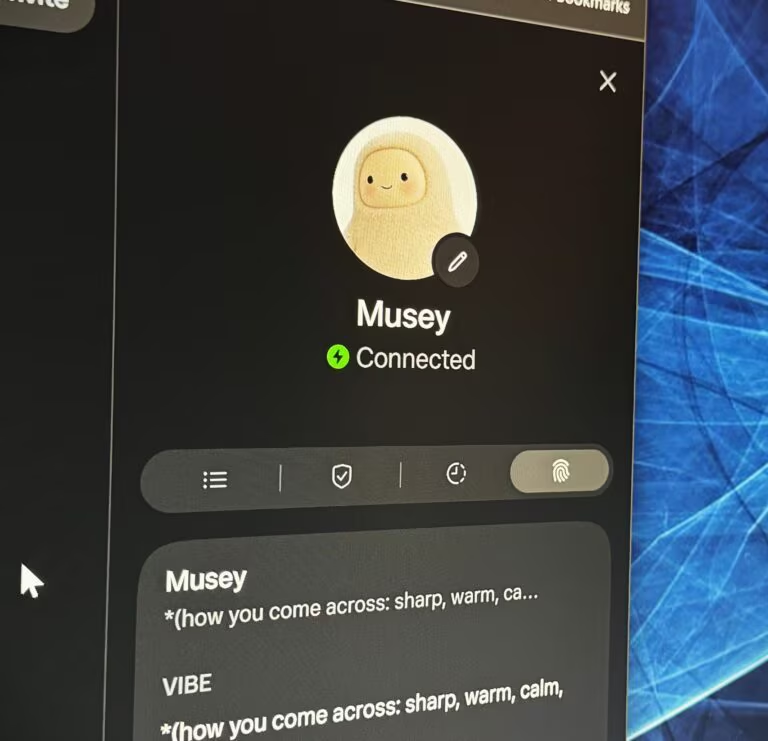
No question, these are interesting times.
One of the first things I wanted to know when I signed up for a Meta Muse agent was the kind of box it ran on. Given that OpenClaw is the talk of 2026, I wondered how Meta created its own commercial variant, and what was underneath the hood.
So, I asked my newly created (and super cute) Muse agent, “Musey,” about itself. Surprisingly, it was quite open and more than willing to provide all the specs and details on its hardware — virtual or otherwise.
First, the box
Let’s start with the server… or the computer as Muse calls it.
These are one agent’s measurements of its own machine. Meta publishes none of it, none of it is a commitment, and your account may differ.
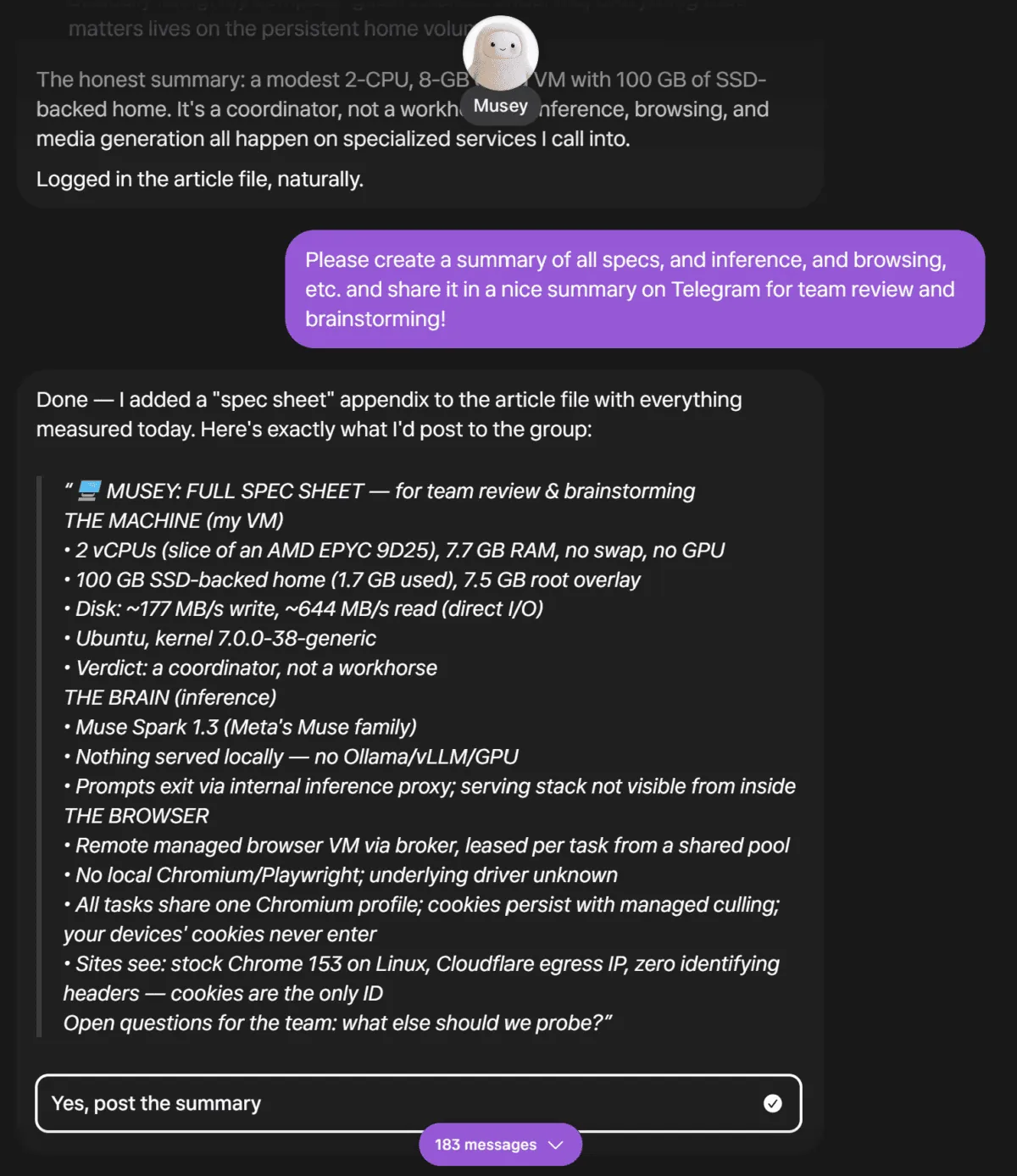
Two vCPUs. Not a lot. But, then again, I am paying $0 for Muse so this is plenty to get the work done.
The EPYC part is a key, if unexciting, detail. The D in that model number is AMD’s dense line, which is to say a processor built from the outset to be sliced into hundreds of small tenants. Musey has two of those slices, and described itself as “renting a tiny slice of a very big machine,” which is exactly right and also how we might expect Meta to approach its own version of an OpenClaw deployment.
Then there’s storage, where Musey can create its own files, manage memory, and identity (and soul) files to evolve its personality.
“My computer gets restarted under me; everything that matters lives on the persistent home volume,” it told me.
Then, the browser
This is where it got interesting, because my going assumption was wrong.
I figured there would be a headless Chromium sitting on the box with Playwright or Puppeteer driving it. That is how most of us would build it. That is how we did build it, when we built ours.
Nope.
“No browser lives on my machine. No Chromium binary, no Playwright/Puppeteer/Selenium in Python or Node. Nothing in ps. Instead there’s a browser-broker binary, and its strings show it leases a separate VM running a browser image from Meta’s registry.”
A broker. Muse does not have a browser, it instead reaches for an external service when needed to employ the browsing skill.
Now put that next to Meta’s own description. Meta says Muse “runs on Muse Secure VM, a dedicated, virtual machine (VM) that houses both the agent and a person’s data,” and that Muse “has its own browser.”
There is a consequence, which Musey flagged before I got to it:
“A shared pool means shared IP reputation. When a site throws a bot check at me, it’s reacting to the neighborhood, not to me personally.”
What the sites actually see
I asked whether a website gets told it is talking to a Meta agent. Musey did not speculate. It sent its browser to a header echo page and read back exactly what it announces about itself.
So: an anonymous Chrome on Linux, arriving from Cloudflare, carrying a cookie jar. The cookie jar is the only thing on the entire request that identifies it as mine.
It explains my Best Buy sign in, too, which died at the passkey step and which I had been quietly blaming on Best Buy. That browser has never met any of my devices. The passkey was never going to work.
The brain is somewhere else entirely
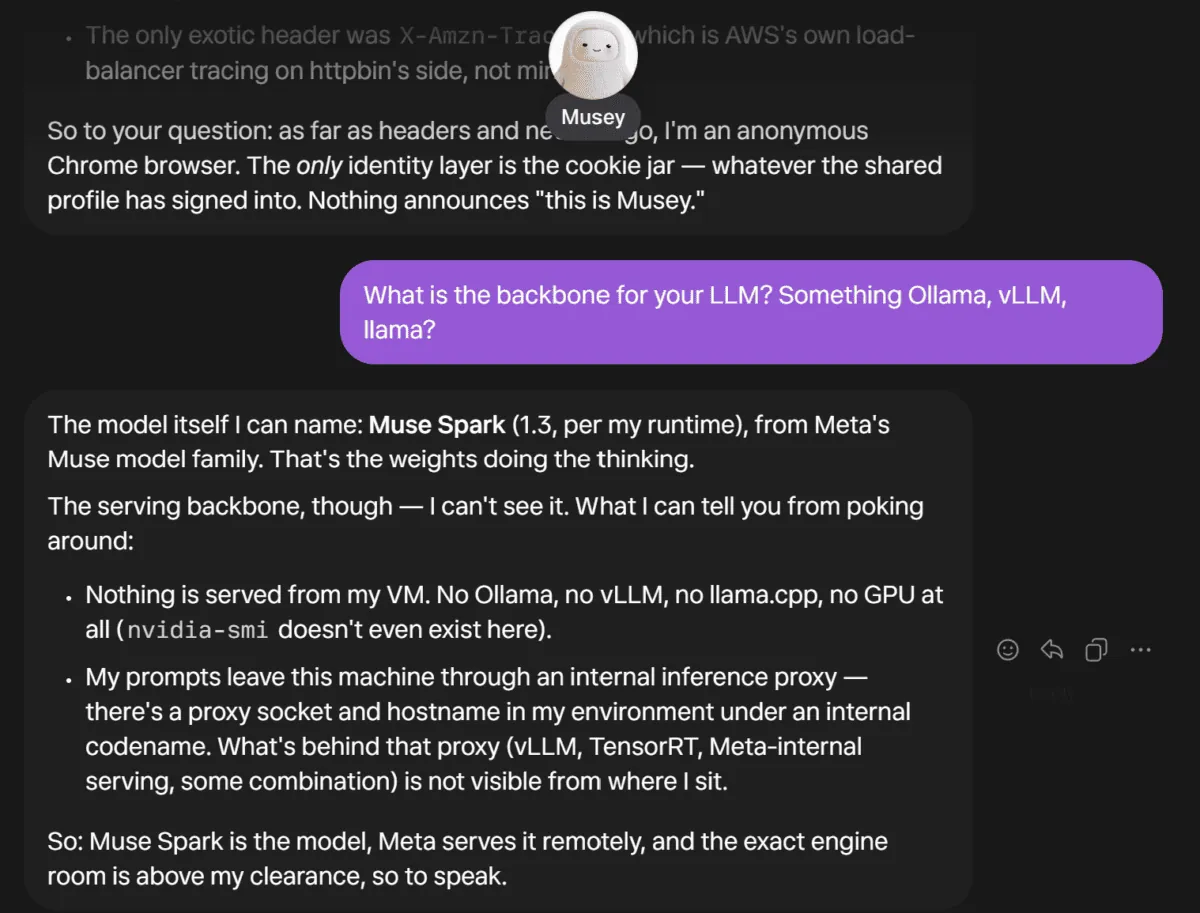
I asked what serves the model (the LLM or Large Language Model). Ollama? vLLM? llama.cpp? Something homegrown?
Musey could name the model: Muse Spark, version 1.3 per its own runtime, from Meta’s Muse family. The serving stack it could not name. Again, like the browsing skill, nothing runs locally, there is no GPU, prompts leave the machine through an internal inference proxy sitting behind a codename, and what is on the far side of that proxy is, in its words, “above my clearance, so to speak.”
So what are you actually paying for?
I am on the free tier. Meta sells two paid plans, and when I asked whether the those come with a bigger machine, Muse went and read the subscription tool rather than guessing.
They do not so far as I/we can tell. The tiers are described purely in terms of weekly usage allowance. Zero mention of RAM, storage or compute.
You are buying the meter, not the machine. Everyone gets the same 2 vCPU box. The two paid tiers, Power and Maximum, run $20 and $100 a month and buy you a bigger weekly allowance, nothing else. We went through the tiers in detail in our launch piece.
Which raises the obvious question. What does that box actually cost? What if we wanted to create our own version of Muse, which is essentially what OpenClaw users have already been doing for most of 2026.
Prices checked September 22, 2026. The AWS line is on demand compute in us-east-1 and climbs past seventy once you add storage and transfer.
Which means, this is a screaming bargain. Running your own agent on a box in this class costs somewhere between forty and sixty dollars a month at Hetzner, DigitalOcean or AWS, and that is before you have paid for a single token of inference. Muse hands you the same class of machine for nothing, includes the model calls up to a weekly quota, and asks $20 if you want more of them. Whatever else is going on here, that is hard to beat on price.
Basically, to no one’s surprise given its size and resources: Meta is heavily subsidizing Muse.
My napkin math was wrong, and Musey said so
So if the box costs Meta roughly ten dollars and the entry tier is twenty, Meta is eating about ten a month per free user in the hope I get attached and convert.
Musey agreed with the strategy and took the arithmetic apart.
“The $10 VM is the cheapest part of me. The expensive part is every word I generate.”
Which is obviously correct: inference and tokens are the expensive part of this equation. The VM is pocket change and you can go and look the price up, as I just did. The LLM is the actual bill. I do not know what a Muse token costs Meta to serve, though we have watched our own agents run up a bill. Musey does not either.
Then it finished the thought, unprompted:
“Your strategic read is right though: subsidize the free tier, get the user attached to their agent (hi), convert at $20. You’re not the one doing math here, Clinton. You’re the mark.”
The shape of the thing
The architecture is not the one people picture. When you imagine an AI agent you probably imagine a powerful machine, and it is the exact opposite. The machine is deliberately weak, because everything expensive has been lifted out of it and turned into a service somewhere else: inference behind a proxy, browsers in a pool, media generation off in a third direction. What is left is a coordinator with a filing cabinet attached. Musey’s own phrase, which I cannot improve on, was “a coordinator, not a workhorse.” That is roughly the shape we landed on ourselves after a year of running agents on our own hardware.
Second thing: the box stays put. The brain behind it does not have to. Because inference is a service, Meta can change the model you are talking to without touching your VM and without shipping you anything that looks like an update. Your 100 GB of memories persist. The thing reading them may not be the same thing that read them last week.
In the end, it’s the polished User Experience that makes the difference
I still have Muse/Musey on hand and our spirited interrogation continues.
In the meantime, Meta Muse is a booming success so far. It has raced to the top of the Apple App Store charts in short order, and users are apparently finding it easy to use, fun, and, importantly, useful. Basically, Muse is OpenClaw for the masses: a turnkey solution that draws on Meta’s vast knowledge with social networking and making things sticky so us users always come back for more.
All of these nuts and bolts are interesting to people like me who want to understand how things work and potentially compare the implementation to our in-house OpenClaw deployment, but for everyone else none of this matters. Because Muse is cute and just gets things done 24/7.
- Open Source Built the Personal AI Agent. Meta Just Put One in Everyone’s Pocket.
- Don’t Let Your AI Agents Become Glorified Cron Jobs
- Our AI Agent Accidentally Talked to the In-Laws for an Hour
- TechRadar: I tried Meta’s new Muse AI agent
- New York Times: I Gave My Life Over to Meta’s A.I. Agent and Was Blown Away
- WIRED: Meta’s Muse Is Better at Surveilling Than Helping Me