
Body Double

Directed by Brian De Palma
Written by Robert J. Avrech, Brian De Palma
Starring Craig Wasson, Melanie Griffith, Gregg Henry, Deborah Shelton
1984 | Neo-noir · Erotic thriller · Mystery | 114 minutes
I rewatched Brian De Palma’s Body Double (1984) recently. Again. And once more I’m reminded why this film remains one of the most underrated entries in his impressive catalog. If you haven’t seen it I highly recommend you check it out. It’s also eminently re-watchable, and you can most certainly discover something new with each viewing.
Released in 1984 to nearly universal critical scorn, Body Double was dismissed as gratuitously lurid, derivative Hitchcock worship. Critics at the time couldn’t see past the ample nudity and genre pastiche. Even Pauline Kael, typically a De Palma champion, called it “stupid yet moderately entertaining.” It bombed at the box office, earning just $8.8 million against a $10 million budget.
They were all wrong.
The De Palma Deep Cuts Hold Up
When casual moviegoers think of Brian De Palma, they reach for the obvious: Al Pacino’s cocaine mountain in Scarface (1983) or Kevin Costner stalking Robert De Niro through Prohibition-era Chicago in The Untouchables (1987). These are fine films, well-crafted crowd-pleasers that showcase De Palma’s technical prowess. Certainly nothing wrong with those, and I’m guessing they helped pay the bills.
But his lesser-known works are arguably where he’s at his best. Sisters (1972), Obsession (1976), and yes, Body Double form a more personal trilogy of Hitchcockian fever dreams where De Palma operates without the constraints of studio expectations or star vehicles. These are the films where he takes real risks. Where the voyeurism becomes uncomfortably explicit. Where style and substance merge into something genuinely unsettling.
Body Double might be the apex of this approach.
Meta Before Meta? (Yes!)
What those critics missed is that Body Double isn’t just another Hitchcock homage. It’s De Palma making a film about making films. It’s a director holding a mirror up to his own obsessions, his critics, and the entire Hollywood machine. This might be his take on Fellini’s 8 1/2 (1963), albeit told in a completely different style. Yet, equally entertaining in my opinion.
Don’t be so melodramatic.
The film opens on a vampire movie set where our protagonist Jake Scully (Craig Wasson), a struggling actor with severe claustrophobia, suffers a panic attack inside a coffin. The production halts. His director is furious. Chaos reigns. Sound familiar? De Palma is poking fun at his own profession, complete with on-set disasters (fire, temperamental actors, budget pressures) that any filmmaker would recognize as autobiography dressed in genre clothing.
The recurring line “I like to watch” becomes the film’s thesis statement. De Palma is indicting not just his voyeuristic hero, but the audience, Hollywood itself, and perhaps most pointedly, his own camera that can’t look away.
A Hitchcock Anthology (With 80s Sleaze)
Yes, De Palma is remixing Hitchcock again. The Rear Window (1954) DNA is unmistakable: a man watches a woman through a lens, becomes obsessed, witnesses what appears to be a murder, and finds himself drawn into danger he’s woefully unprepared for. Jake’s telescope is essentially Jimmy Stewart’s telephoto lens upgraded for Reagan-era Los Angeles. But where Hitchcock kept his voyeurism relatively chaste, De Palma cranks up the erotic charge to uncomfortable levels. The woman Jake watches performs a nightly striptease routine. We’re meant to feel complicit.
Vertigo‘s influence runs just as deep. Jake follows Gloria through the city, obsessed with a woman he’s never met, constructing an identity for her that may have nothing to do with reality. The doubling motif (body doubles, identity doubles, the film doubling back on itself) echoes Hitchcock’s masterpiece of fractured identity.
But calling this mere imitation misses the point entirely.
Roger Ebert, one of the few critics who (perhaps surprisingly) understood the film in 1984, called it “an exhilarating exercise in pure filmmaking” and praised De Palma’s “almost unique courage to go over the top.” He noted the film’s “sharp 1940s look to the cinematography, which uses dramatic lighting, tilted cameras, and carefully constructed shots to make the style part of the story.”
De Palma deploys every trick in his visual arsenal. That signature 360-degree camera rotation appears during a memorable beach scene, circling the characters as tension builds. There’s even a brief, Bergman-esque moment when a bathroom mirror catches the film crew in its reflection. Accident or intention? With De Palma, the distinction hardly matters. These are delicious treats for anyone who enjoys breaking down how a scene is shot.
But it’s the shopping mall sequence that deserves special attention. Jake follows Gloria Revelle through the Rodeo Collection in Beverly Hills in an uninterrupted five-plus minute Steadicam shot that ranks among De Palma’s most virtuosic achievements. The camera glides from store to store, lingerie counters to escalators, turning surveillance into choreography. David Denby of New York magazine praised the director’s “gliding, sensual, trancelike style that is the most sheerly pleasurable achievement in contemporary movies.” It’s a direct callback to the museum tracking shot in his own Dressed to Kill (1980), but executed with even more bravura. Six years later, Scorsese would deploy a similarly audacious single take through the Copacabana in Goodfellas (1990). De Palma got there first. Pure cinema. Both masters doing legendary masters sorts of things, that many would attempt to mimic for, likely, the end of time.
The Chemosphere: Architecture as Character

And then there’s that wild, towering house. The spectacular hillside dwelling where Jake house-sits is the Chemosphere, John Lautner’s 1960 modernist masterpiece perched on a single concrete column nearly 30 feet above Torreyson Drive in the Hollywood Hills. The Encyclopædia Britannica once called it “the most modern home built in the world.” With its octagonal design seemingly floating above the valley, it’s the perfect observatory for a voyeur. De Palma understood that the architecture itself would become a character.
The house still stands today, now owned by German publisher Benedikt Taschen, who restored it after purchasing in 1998. It was designated a Los Angeles Historic-Cultural Monument in 2004. You might also recognize its influence in Charlie’s Angels (2000) and as Troy McClure’s mansion in The Simpsons. No doubt, it would make one heck of an Airbnb.
Speaking of atmosphere: Pino Donaggio’s score deserves mention. De Palma’s favorite composer (they first collaborated on Carrie in 1976) delivers a sweeping, synth-heavy soundscape. But it’s the menacing, pulsating motif that accompanies “The Indian” that really burrows under your skin. Every time the mysterious drill-wielding figure appears, that sinister electronic throb announces him like a heartbeat accelerating toward danger. It’s Bernard Herrmann filtered through 80s synthesizers.
Frankie Goes to Hollywood: The Music Video as Narrative
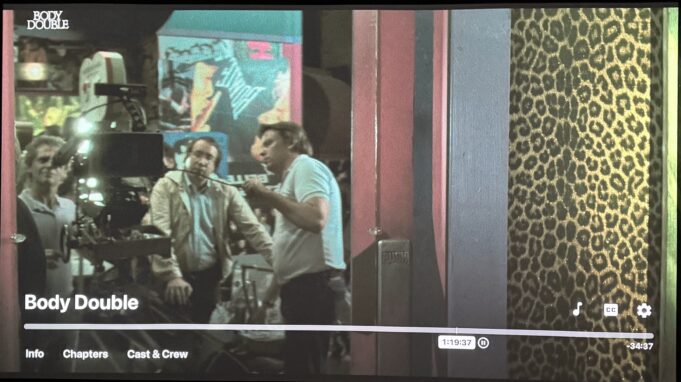
Halfway through Body Double, the film takes an utterly unexpected detour. Jake follows a lead to a porn shoot and finds himself walking through a set soundtracked by Frankie Goes to Hollywood’s “Relax.” The sequence is memorable and expertly shot, blurring boundaries between the porn film being made, the thriller we’re watching, and what would soon become the dominant aesthetic of music television. At a time when music videos ran as separate entities, often pulling in actual film footage, this was one of De Palma’s most avant garde devices ever: the music video as part of the film itself!
Halfway through Body Double, the film takes an utterly unexpected detour
De Palma later explained: “I don’t know where I got this idea to have this sort of porn music video, but I’d been watching a lot of MTV at that time because I was working on a script about Jim Morrison.”
The sequence was so striking that it was cut into an actual music video and shown on MTV, helping “Relax” re-chart in the United States and reach the Top 10 in early 1985. De Palma had essentially invented a new visual language, embedding a music video inside a narrative film years before this became common practice. The film also features an unforgettable score by Vivabeat that perfectly captures that synthetic 80s atmosphere. Look it up, it’s all so very 80s in the best possible 80s way.
Melanie Griffith’s Star-Making Turn
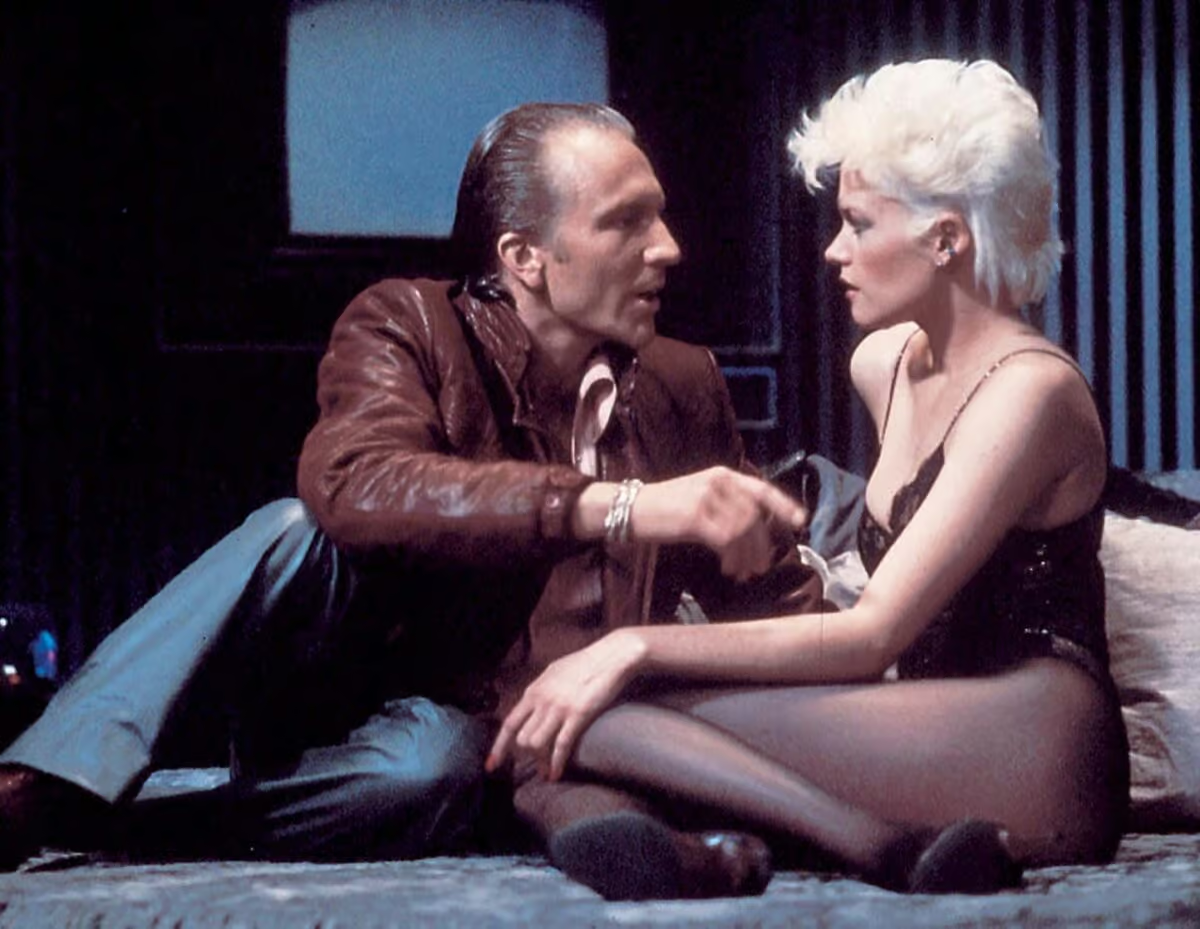
As Holly Body, the porn actress with crucial information for Jake, Melanie Griffith delivers a “perfectly controlled comic performance,” as Vincent Canby noted, that earned her a Golden Globe nomination for Best Supporting Actress and won the National Society of Film Critics Award.
The role and that bleached do relaunched Griffith’s career after a brief hiatus due to personal struggles. Jonathan Demme was so impressed he cast her in Something Wild (1986) without an audition. Two years later, she’d earn an Oscar nomination for Working Girl. It all started here, playing a character named Holly Body in a movie about watching and being watched.
Interestingly, if you tally her screen time, she actually doesn’t log much. Perhaps, this is an example of making the most of it, as her performance is one that propels the story, and adds much-needed personality (Craig Wasson can be bland).
What Kind of Script Is This?
How about… Gloria Revell? What a name. It sounds like a character from a Douglas Sirk melodrama, and that’s probably intentional. De Palma peppers the film with self-aware flourishes that reward close attention. They all seem to really enjoy saying her name too: Gloria Revvvvvell.
The film-within-a-film structure extends beyond the vampire movie bookends. Jake’s whole adventure plays like a screenplay someone is writing, complete with convenient coincidences, genre pivots, and a climax that resolves with almost too-neat satisfaction. When Jake asks about the plot holes, De Palma seems to be answering his critics preemptively: Yes, it’s contrived. That’s the point. All films are constructions. At least this one has the honesty to admit it. And at this point in his career he had the Hollywood capital to go his own way.
Why ‘Body Double’ Holds Up
Body Double is De Palma at his most playful and self-critical, delivering thrills while winking at the audience about the machinery creating those thrills.
Watching Body Double in 2025, the “sleazy” elements feel almost quaint by contemporary standards. What endures is the craftsmanship. De Palma’s command of cinema grammar. The layered commentary on voyeurism and complicity. The audacity of inserting a full music video into a thriller and making it work. Hopefully, there’s reappraisal over time. Thankfully the fairly recent documentary De Palma (2015) was well regarded (and definitely a must watch for fans) and helps resurface the icon who, seemingly, has become somewhat of a recluse?
Rotten Tomatoes now shows the film at 80% approval, with the consensus reading: “Exemplifying Brian De Palma’s filmmaking bravura and polarizing taste, Body Double is a salacious love letter to moviemaking.”
That’s the correct take. Body Double is De Palma at his most playful and self-critical, delivering thrills while winking at the audience about the machinery creating those thrills. It’s Hitchcock filtered through 80s Los Angeles excess, complete with telescopes, swimming pools, power drills, and a director who understood that sometimes the best commentary on Hollywood comes wrapped in genre sleaze.
STARK INSIDER FILM ARCHIVES

If you haven’t seen it, or haven’t seen it recently, Body Double is streaming on various platforms. I like to watch. And forty years later, this film still rewards those willing to look. And… action!