
Microsoft quietly launched So.cl, its attempt (perhaps) to enter the social networking space. The limited release first targeted educational institutions before becoming more broadly available over the weekend.
I’d hazard a guess that Microsoft’s foray has scared the dickens out of Facebook investors, resulting in a dramatic 10% drop today (as of this writing) in the share price of the newly minted FB stock.
Of course, that would be ludicrous.
But why not heap it onto the pile of potential excuses for the under-whelming IPO: NASDAQ technical glitches, panicky retail investors, the hoodie, over-inflation of the user count…. ? Hint: check out the P/E for the real underlying issue, and it concerns valuation and good old-fashioned moula.
So.cl meantime is a bit of a mystery.
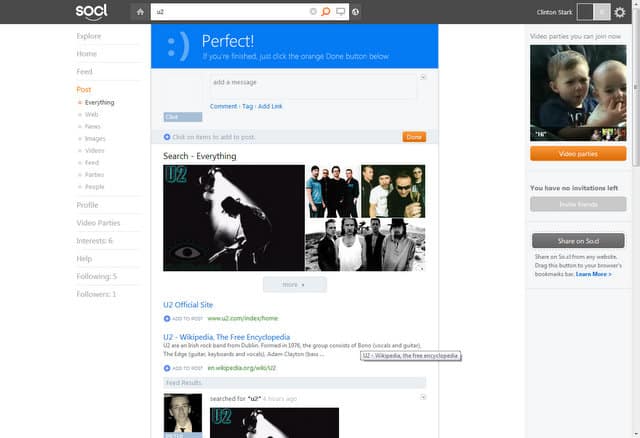
I logged into the social network using my Facebook credentials; a slightly inauspicious way for Microsoft to welcome me to its view of social networking. To be fair, Microsoft has stated (somewhere, in the fine print) that So.cl (Southern California?) is really not intended to compete with the likes of Twitter and Facebook. That’s a good thing, because so far, in my testing at least, it operates like a Google+ knock-off (with familiar three-column presentation to boot) sitting on top of the Bing search engine.
For example, in the box at the stop that asks “What are you interested in?” I type “U2.” I’m presented with results that look similar to what I might see if I were to just type the query into Bing. There’s one small difference — a meaningful one, Microsoft hopes. I can also see what others are saying about U2, and who else is searching for information about the band. This is a light-weight example, and if I were to extend the thinking into something serious and meaningful, say, cancer research, the utility here could become far more interesting. I might discover a community of like-minded scientists who are sharing knowledge, information, results.
I wonder, however, if there is differentiation. Facebook has interest lists, and Google+ has circles. Twitter also has a lists features that works well enough. All of these networks allow users to create community, and all of them have a huge head-start on Microsoft. If So.cl had come out four years ago, we’d likely sing its praises: easy to use, pretty, informative. How (overly) social we are today, what with Pinterest, Path, Instagram, Highlight, Foursquare, and, of course, Twitter and Facebook. Is there really room in our lives for yet another me-too social network?
One thing So.cl does (partially) well is topics. Upon login you’re presented with a Flipboard-like assortment of potential topics — tech, arts, music, movies, science, architecture, among many others — that might be of interest. I clicked on “science” and then “follow.” The results that appeared in my feed were less than inspired, however. I got a mumble-jumble of status updates, search results and photos all loosely related to the broad category of science. Curation, so well done on Flipboard, is notably absent.
Again, this is an early offering, with apparently humble aspirations. Still, So.cl proves that it’s very easy to copy Facebook or Google+ at least in terms of aesthetic. The hard part is gaining critical mass, active community, and returning visitors.