Skip to content
Stark Insider
  • Culture
  • Filmmaking/Tech
  • Atelier Stark Films
Tech

Malcom Gladwell on the real genius of Steve Jobs

No stranger to entertaining readers, Gladwell nips and tucks key passages from Walter Isaacson's "Steve Jobs" and assembles his own thoughtful retrospective.

BY Clinton Stark — 11.08.2011

The New Yorker
Malcolm Gladwell's part-review, part-retrospective is one of the best I've read yet.
Malcolm Gladwell’s part-review, part-retrospective is one of the best I’ve read yet.

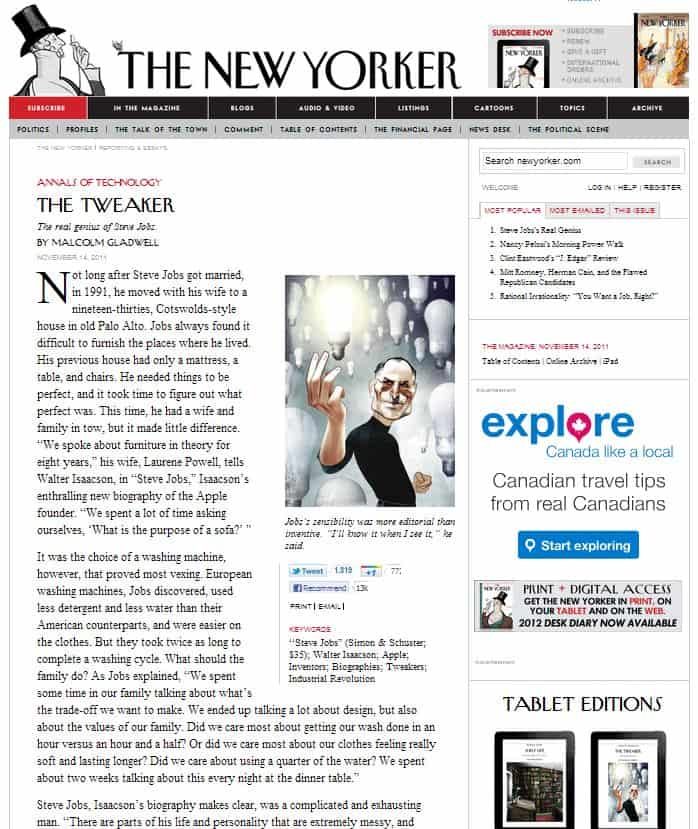
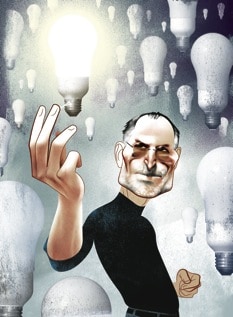
Malcolm Gladwell, in a thoughtful piece in The New Yorker, refers to Steve Jobs as “the tweaker.” He may have been brilliant, but his inventing was of the editorial kind. “I’ll know it when I see it,” Jobs is quoted as saying, frustrating designers and developers who wanted more to go on.

Most refreshing, though, about Gladwell’s take on the legend and his bio is its balanced examination of a man who relentlessly pursued perfection yet was far from it himself. Many gloss over the fact that Jobs once fathered a child, denied it, and abandoned the mother. “Steve Jobs, Isaacson’s biography makes clear, was a complicated and exhausting man.”

No stranger to entertaining readers, Gladwell nips and tucks key passages from Walter Isaacson’s “Steve Jobs” and assembles his own thoughtful retrospective.

Like me, if you have yet to read the bio you’ll find this a remarkable abstraction, taking us from the kitchen table where the Jobs family discusses the merits of European washers and the requirements of family laundry, and the compulsive-obsessive behavior that had him lambasting hospital staff over the design of an oxygen monitor to his outward hatred for Google (“Outside of Search, Google’s products—Android, Google Docs—are shit”) and his last days obsessing over the design minutia of Apple’s new HQ in Cupertino.

I admit to not being well-versed in Gladwell’s Blink and The Tipping Point; after reading his thoughtful piece in The New Yorker, I may just go and pull those classics off the shelf.
The New Yorker

Related Stories

2026 Artificial Intelligence Index Report from Stanford HAI

Stanford's 2026 AI Index: Where AI Actually Stands (report)

News
Ethereal oil painting in blue and ochre tones showing overlapping figures emerging from an atmospheric haze, representing accumulated memory and continuity in human-AI collaboration. Original artwork by Loni Stark.

What Happens When the AI Remembers You

Tech
Diagram showing how Google's TurboQuant compresses high-dimensional AI vectors into a compact quantized grid, with four colored vector arrays (green, blue, red, pink) mapping to and from a central quantization matrix

Can You Fit a 70B Model on a Single RTX 5090? Google's TurboQuant Says Yes

Tech
Claude Code conversation showing how it initially built deterministic scripts for the Finn financial scout agent before being redirected toward heartbeat-driven agentic design with OpenClaw

Don't Let Your AI Agents Become Glorified Cron Jobs

Tech

More in Tech →

Clinton Stark

Filmmaker and editor at Stark Insider, covering arts, AI & tech, and indie film. Inspired by Bergman, slow cinema and Chipotle. Often found behind the camera or in the edit bay. Peloton: ClintTheMint.

Short Films
Loni Stark - A West Coast Adventure - A Lifetime in the Making - Stark Insider

Stark Insider
  • CULTURE
  • BEST OF AI
  • FILMMAKING/TECH
  • ATELIER STARK FILMS
  • HUMANxAI SYMBIOSIS
THE STARK COLLECTIVE
  • THE STARK CO
  • STARK INSIDER
  • STARKMIND
  • ATELIER STARK
© Copyright 2005-2026 BLG Media LLC. v2.18.1
  • Review Policy and Shipping
  • Privacy Policy
  • Contact
  • About