Skip to content
Stark Insider
  • Culture
  • Filmmaking/Tech
  • Atelier Stark Films
Tech

Google Android takes market share from RIM and Microsoft (again)

What continues to amaze me is that only a few years ago Google was not even a player in the space.

BY Clinton Stark — 11.03.2011

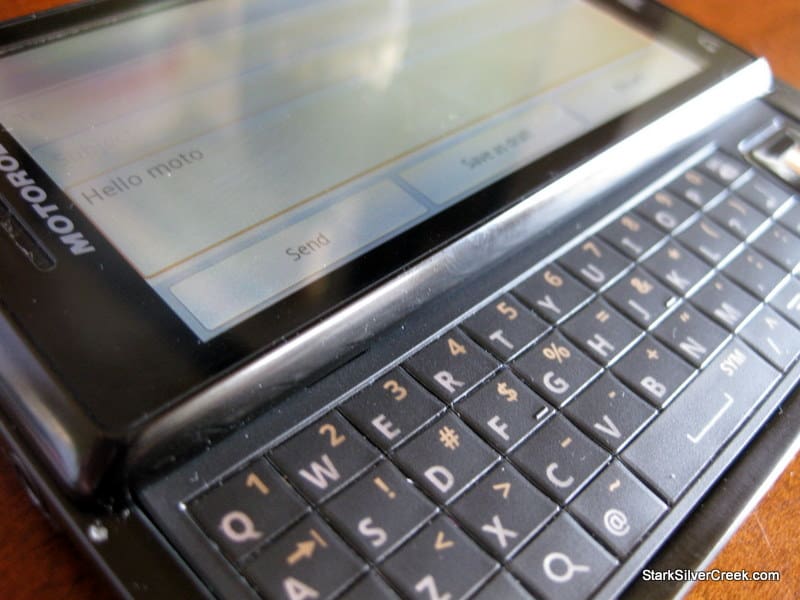
The Android boom started with the release of the Motorola Droid on Verizon in November 2009.

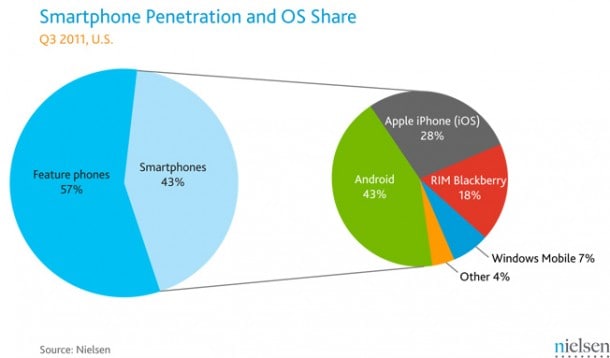
Nielsen Smartphone Penetration Q3 2011

Android continues to roll. Although the last few days have been slightly bumpy for Google–buggy Gmail app angering the faithful, then a Gmail web refresh receiving mixed reviews–at least it can count on its world beating mobile OS to deliver the goods.

According to Nielsen which just reported on Q3 mobile share, Android gained 4% Q/Q, while others stayed flat (Apple iOS) or fell (RIM). When it comes to smartphone vendors, though, Apple still comes out on top with 28% share of the US market.

Is the mobile market saturated?

Of particular interest were the levels of market saturation. With a penetration rate of 62%, 25-34 yr-olds are the most likely to own a smartphone. According to Nielsen, “After younger adults, the segment with the second fastest-growing smartphone penetration rate is those aged 55-64. Smartphone penetration among this older group is only 30 percent, but it jumped 5 percent this quarter.”

Motorola Droid
The Android boom started with the release of the Motorola Droid on Verizon in November 2009.

What continues to amaze me is that just a few years ago Google was not even a player in the space. That means in a period of about 24-months the company was able to (1) bring to market an open source OS; (2) sign-up significant numbers of partners (HTC, Motorola, Samsung) to design and sell handsets; (3) establish strong presence at point of sale (most notably Verizon in the “early” days); (4) persuade a massive army of developers to build apps; and, most importantly, (5) get consumers excited and ready to buy an Apple smartphone alternative with equal appeal.

Tags:Android Google

Related Stories

2026 Artificial Intelligence Index Report from Stanford HAI

Stanford's 2026 AI Index: Where AI Actually Stands (report)

News
Ethereal oil painting in blue and ochre tones showing overlapping figures emerging from an atmospheric haze, representing accumulated memory and continuity in human-AI collaboration. Original artwork by Loni Stark.

What Happens When the AI Remembers You

Tech
Diagram showing how Google's TurboQuant compresses high-dimensional AI vectors into a compact quantized grid, with four colored vector arrays (green, blue, red, pink) mapping to and from a central quantization matrix

Can You Fit a 70B Model on a Single RTX 5090? Google's TurboQuant Says Yes

Tech
Claude Code conversation showing how it initially built deterministic scripts for the Finn financial scout agent before being redirected toward heartbeat-driven agentic design with OpenClaw

Don't Let Your AI Agents Become Glorified Cron Jobs

Tech

More in Tech →

Clinton Stark

Filmmaker and editor at Stark Insider, covering arts, AI & tech, and indie film. Inspired by Bergman, slow cinema and Chipotle. Often found behind the camera or in the edit bay. Peloton: ClintTheMint.

Short Films
Loni Stark - A West Coast Adventure - A Lifetime in the Making - Stark Insider

Stark Insider
  • CULTURE
  • BEST OF AI
  • FILMMAKING/TECH
  • ATELIER STARK FILMS
  • HUMANxAI SYMBIOSIS
THE STARK COLLECTIVE
  • THE STARK CO
  • STARK INSIDER
  • STARKMIND
  • ATELIER STARK
© Copyright 2005-2026 BLG Media LLC. v2.18.1
  • Review Policy and Shipping
  • Privacy Policy
  • Contact
  • About