
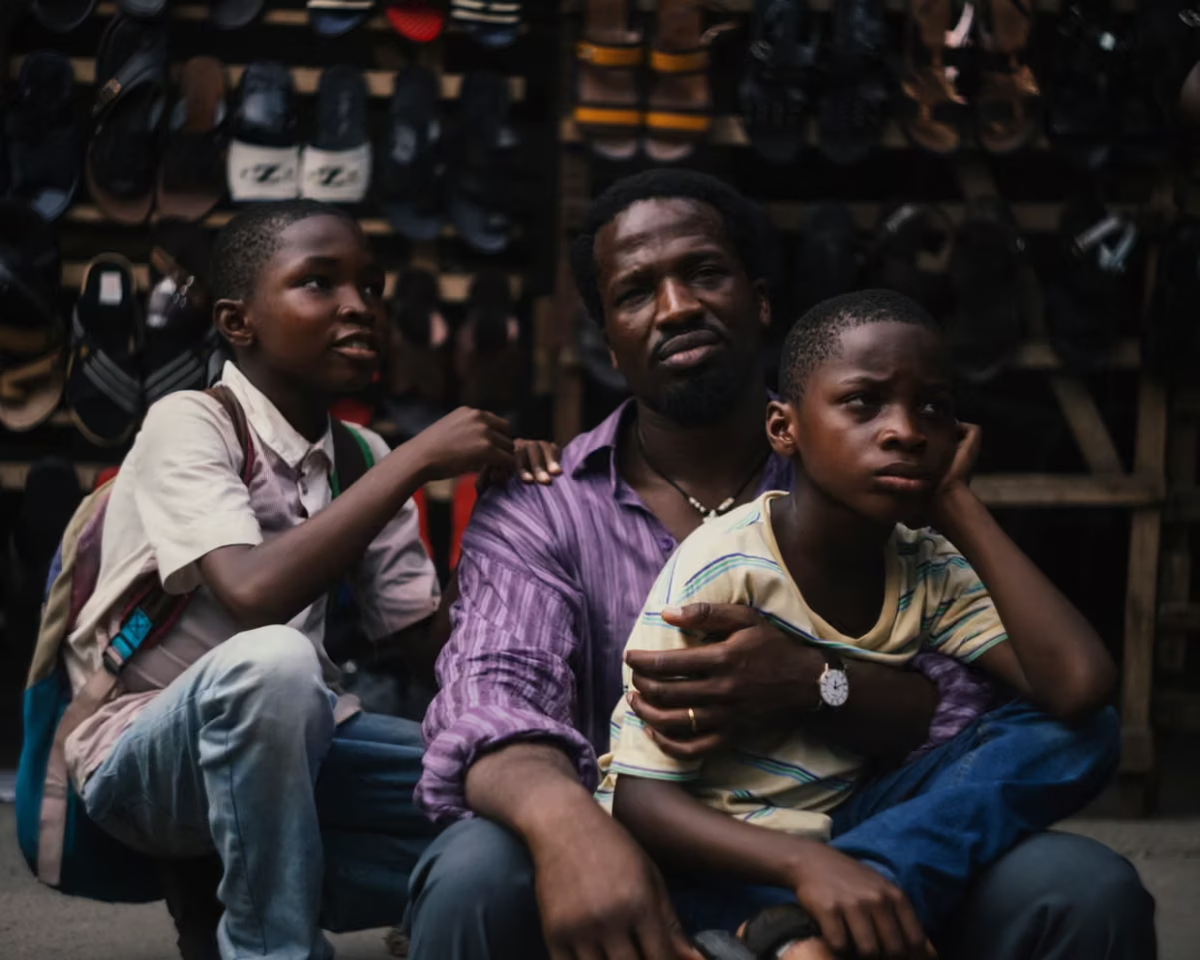
My Father’s Shadow

Directed by Akinola Davies Jr.
Written by Wale Davies, Akinola Davies
Starring Sope Dirisu, Chibuike M. Egbo, Godwin C. Egbo
2025 | Drama | 1h 34m | United Kingdom · Nigeria · Ireland
On the Reddit-t/movies website, director Akinola Davies Jr. is quoted as saying:
“My feature debut, My Father’s Shadow, was the 1st Nigerian film selected for the Cannes official competition, was UK’s entry for International Feature at this year’s Oscars & is nominated for the Best Debut at the BAFTAs.” (he went on to win)
In another interview, he takes pains to point out that other Nigerian films have been shown at Cannes, just not in the official competition slot. And while the western gaze matters, it is not the most important factor in evaluating a film.
And well he should be proud of My Father’s Shadow. This directorial debut is about duty to and love of family, about the yearning of children to be close to a parent, and about the choices a father has to make in the face of political turmoil and possible civil war.
With the film set in 1990s Nigeria and partially autobiographical, director Akinola Davies Jr. and his brother Wale Davies have written about hope and loss and memory in a way that appeals to all cultures. Cinematography and music welcome you and bring back memories of your own childhood dreams.
Sope Dirisu as their father Fola brings a strong Nigerian background to this role, but he still had to spend hours and hours studying Yoruba because he has spent much of his adult life in the UK. The film is in Yoruba, pidgin and English, with subtitles.
Focus is on the two sons, Remi and Akin, played by actual siblings Chibuike M. Egbo and Godwin C. Egbo. Their mother goes to her job every day and their father has been absent for a while, working in Lagos. In desultory exchanges on their front porch, the boys exhibit mild sibling rivalry and restlessness. They dream of seeing their father again; it has been months.
Fola appears in their village home, as if by magic. Tall and imposing, he questions his sons about homework and chores. They hang on his every word. In a surprise decision, he decides to let them accompany him to Lagos, where he must go to collect back pay.
Remi and Akin change their clothes and run after Fola as he strides to pick up the jitney bus. We witness aspects of village life as people keep climbing onto the crowded bus, some with livestock. There is lively talk of the coming election and how most voters want change from military rule.
When the jitney bus or danfo runs out of fuel, passengers are irritated but resigned. Fola and his boys hitchhike to Lagos. His sons, aged 8 and 11, are fascinated by the city. Huge vendor markets with white cows resting under open shelters. Trucks, buses, vans, river barges. Women balancing baskets on their heads. Polo horses of the wealthy are trotted through, and Fola explains polo to the boys. Minarets where muezzins call the faithful to prayer. Army jeeps with armed soldiers pass slowly, and Fola stiffens when he sees them.
Throughout the many adventures that fateful day, Akin rarely takes his eyes off his father, and learns so much about Fola, processing it all with his 11 year old mind. Who is the beautiful waitress in the open-air cafe? Who is the elder to whom Fola is so deferential, and who lets the boys play in his closed amusement park? Why does his father give the soldiers such a hard gaze? Why is everyone talking about the Bonny Camp massacre that happened 10 days earlier? And that special afternoon at the seashore when Fola apologizes for his long absences.
Throughout Lagos, change is anticipated. Citizens sip their beverages in cafes and chat while watching the television screens, waiting for news of the national election. They want Abiola in charge of a new government, but will they be stuck with Tofa again?
An electrifying announcement on television infuriates citizens. People take to the streets. Cars are overturned and set on fire. The government sends in troops. Fola has one goal — to get his sons home safely. But first, he has to get past a soldier who is convinced he remembers Fola from 10 days earlier.
A father’s shadow looms large and runs deep. Fola knows his duty and performs it heroically. A genuinely powerful film for what it shows of struggle and loyalty to family. And also for what it says about how hard it is to keep a democracy when those in power nullify election results for personal gain.